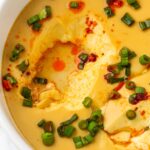
Chinese Steamed Eggs
These traditional Chinese Steamed Eggs are silky smooth, jiggly, and pure comfort when it comes to Cantonese home cooking. Learn the foolproof method to make this easy steamed egg recipe every time!
Servings: 4 people
Calories: 54kcal
Equipment
- 8-inch ceramic bowl heat-proof
- 9- or 10-inch heat proof ceramic plate to cover the bowl
Ingredients
- 3 large eggs equiv to ⅔ cup in volume approx
- 1 ⅓ cups chicken broth or double the volume of eggs, see instructions for measuring tips
- A pinch of salt
Topping, for serving:
- 2 teaspoons chicken broth
- 1 teaspoon light soy sauce
- 1 scallion thinly sliced - green part only
- Sesame oil to taste
Instructions
- Prepare the steamer pan: Add about 1 inch of water to the bottom of the steamer pan, insert the steamer basket insert, and cover. Bring to a steady simmer over medium-low to medium heat.
- Measure egg and broth volumes: Crack the eggs into a glass measuring cup and note their volume. Then, measure out exactly twice that volume in chicken broth. Since 3 eggs usually fill up 2/3 of a cup, you will need 1 ⅓ cups of broth total (two times 2/3 = 1 ⅓ cups).
- Warm up the broth and combine: Microwave the broth until warm to approximately 115°F. This helps to temper the eggs for even cooking. Beat the eggs until well and evenly combined, then whisk in the warm broth. Season with a pinch of salt.
- Strain the egg mixture: Using a fine-mesh strainer, strain the egg mixture into a medium shallow 8-inch ceramic bowl. Gently remove any bubbles on the surface by dabbing it with paper towel.
- Assemble in the steamer: Place the bowl with the eggs in the steamer basket. Then, carefully cover the bowl itself with a heat-proof ceramic plate. This prevents any water droplets from falling onto the surface.
- Cover and steam: Cover with the lid tightly and steam over medium heat for 12 minutes. Tip: Make sure the water is on a constant and steady medium-ish boil for even heat distribution.
- Let it rest inside: After the 12-minute mark, turn off the heat (do not open the lid), and let it rest inside for 2-3 minutes. Then, uncover. The edges should be mostly set, but the center should be still a little jiggly, silky, and smooth. If it looks watery or not set yet, continue steaming.
- Topping and serving: In a bowl, mix 2 teaspoons of chicken broth with 1 teaspoon light soy sauce, and a touch of sesame oil. Top the steamed eggs with it, then garnish with sliced scallions. Enjoy!
Video
Notes
- Equipment notes: Make sure that after you put the bowl and plate into the steamer, that the lid can close tightly in order to trap all the steam inside.
- Measure by liquid volume: Measure the cracked eggs in a measuring cup first to determine the exact broth amount needed. The old school way is to use the egg shells to measure the liquid, either way works, but a measuring cup is more accurate.
- Use warm broth (approx 115°F). This tempers the eggs for a faster, more uniform set.
- Strain! Always pour the mixture through a fine-mesh strainer into the bowl to eliminate air bubbles.
- Why cover the eggs with a plate: Prevents the water from condensation collected on the lid from falling on the surface. Some people cover with plastic wrap, but I’m always nervous about plastic and heat.
- Steady heat, rolling simmer: Maintain a steady rolling simmer (between medium-low to medium). Avoid a strong boil, which can lead to a rubbery texture, or not enough heat to create steam.
- Let it rest. For this recipe, steam for 12 minutes, turn off the heat and don’t open the lid, and let it rest undisturbed for 2-3 minutes. Residual steam finishes cooking the center gently.
- How to tell when it’s ready. The center should jiggle slightly, while edges should be mostly set. It shouldn’t look liquid-y or too firm.
- Chicken broth: Water or vegetable broth. If using water, add an extra pinch of salt or chicken bouillon powder.
- Toppings: Aside from a drizzle of soy sauce, try chili oil or chili crisp.
- Add-ins: Shrimp, clams, or minced beef are popular. Add them (uncooked) into the bowl with the egg mixture before steaming.
Disclaimer: Nutritional values (per serving) are approximates only.
Nutrition
Calories: 54kcal | Carbohydrates: 1g | Protein: 5g | Fat: 3g | Saturated Fat: 1g | Polyunsaturated Fat: 1g | Monounsaturated Fat: 1g | Trans Fat: 0.01g | Cholesterol: 124mg | Sodium: 431mg | Potassium: 72mg | Fiber: 0.1g | Sugar: 1g | Vitamin A: 210IU | Vitamin C: 1mg | Calcium: 24mg | Iron: 1mg