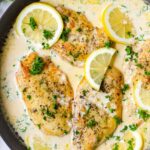
Easy Creamy Lemon Chicken
This easy skillet creamy lemon chicken is a winner! Tender pan-seared chicken served with a creamy and tangy lemon garlic sauce. It's a quick 30 minute weeknight option!
Servings: 4 people
Calories: 449kcal
Ingredients
For the chicken cutlets:
- 2 large chicken breasts or 4 medium chicken cutlets
- 1 teaspoon Italian herb seasoning
- Salt and pepper
- ½ cup all-purpose flour
- Olive oil
Fro the creamy lemon sauce:
- 2 tablespoons unsalted butter
- 3 cloves garlic, minced
- ½ cup chicken broth
- 2 tablespoons lemon juice, freshly squeezed plus more to taste
- 1 cup heavy cream do not substitute, see notes
- Salt and pepper to taste
- Fresh chopped Italian parsley for garnish
- Lemon slices for garnish
Instructions
- Prep chicken cutlets: Slice each chicken breast in half lengthwise to get thinner cutlets. Over plastic wrap, slightly pound the chicken to even thickness as needed using a meat mallet. This is for even cooking and to tenderize the chicken.
- Season and dredge chicken: Season both sides of the chicken cutlets with salt, pepper, and Italian seasoning (per chicken cutlet, use about ¼ teaspoon each: Italian seasoning, Kosher salt, and ground black pepper). Dredge the seasoned chicken in flour and shake off any excess.
- Sear chicken: Heat a few generous drizzles of olive oil in a large 12-inch nonstick skillet over medium heat. Sear the chicken on both sides, about 4-5 minutes per side undisturbed, until golden brown and fully cooked through. Remove from the pan and set aside.
- Start the sauce: Don’t wipe the skillet clean. Melt 2 tablespoons unsalted butter, then sauté garlic until fragrant. Add the chicken broth plus 1 tablespoon lemon juice until warm. Taste it, and add the second tablespoon of lemon juice if desired (I ended up adding 2 tablespoons).
- Add heavy cream: Turn down to low heat. Bring to a very light simmer. Then, stir in heavy cream, and season with salt and pepper to taste.
- Return chicken to pan and bring back to a low simmer. Simmer for another 3-5 minutes until the sauce has thickened a bit.
- Serve with lemon slices, a few grinds of black pepper, and freshly chopped parsley. Enjoy!
Video
Notes
- Always use heavy cream. Do not use milk or half-and-half. Heavy cream is stable and high in fat content, which is what prevents lemon sauces from breaking when combined with dairy. If you want a thinner sauce, add more broth instead.
- Use FRESH lemon juice, not bottled, for best flavor. Also, start with less to adjust for your preferred level of tartness. You can always add more.
- Use low heat and low simmer. High heat will cause the sauce the break.
- Pound chicken to even thickness: Even chicken cutlets have thicker ends. Use a meat mallet to pound them to uniform thickness for consistent cooking and so they stay tender.
- Do not wipe the brown bites! Deglaze instead. This is what makes the sauce so flavorful.
- Do not skip the flour dredge for the chicken. Not only does the coating create a golden crust, it also helps the sauce cling to the sauce better and helps it thicken.
- Make ahead and storage: Let the finished dish cool down, store in an airtight container for up to 3 days.
- Reheating: Microwave or skillet over low heat, adding a splash of broth to loosen up sauce.
- Freezing is NOT recommended (cream sauce separates).
- If it curdled: Lower the heat quickly, then whisk in a splash of cream and broth until re-emulsified.
- Too tart: Add more cream or broth.
- Too thin: Simmer a little longer gently until thickened (it will thicken as it cools down too), or stir in freshly grated Parmesan.
- Boneless chicken thighs work too; sear 1 to 2 mins longer.
- Full chicken breasts need longer cooking or finish in the oven first.
- Extra seasoning for chicken: Try fresh herbs (thyme, rosemary) for 20 min before cooking.
- Stir in freshly grated parmesan cheese for extra richness.
- Add greens, such as baby spinach, as sauce simmers
Disclaimer: Nutritional values (per serving) are approximates only.
Nutrition
Calories: 449kcal | Carbohydrates: 15g | Protein: 27g | Fat: 31g | Saturated Fat: 18g | Polyunsaturated Fat: 2g | Monounsaturated Fat: 9g | Trans Fat: 1g | Cholesterol: 169mg | Sodium: 263mg | Potassium: 528mg | Fiber: 1g | Sugar: 1g | Vitamin A: 1093IU | Vitamin C: 7mg | Calcium: 63mg | Iron: 1mg